
How to choose a wedding photo sharing app
Updated on 9 November 2026 · 5 min read
In short
To choose a wedding photo sharing app, start with what your guests will go through: do they have to install something or create an account? Every extra step costs you photos. Then check the quality of the files, where they are hosted, facial recognition, when the photos are revealed, the photographer's role, moderation, how long the album is kept and the price. For each point, this guide also explains what Festiroll chose.
No app to install, no account
This is the point that decides how many photos you receive: a guest who has to download an app, then create an account, often gives up before taking a single photo.
There are three kinds of solution:
- apps to install: every guest has to download them first;
- general-purpose shared albums and group chats: familiar to many, but they need an account, or membership of the group;
- web apps: a QR code opens the album in the phone's browser, with nothing to install.
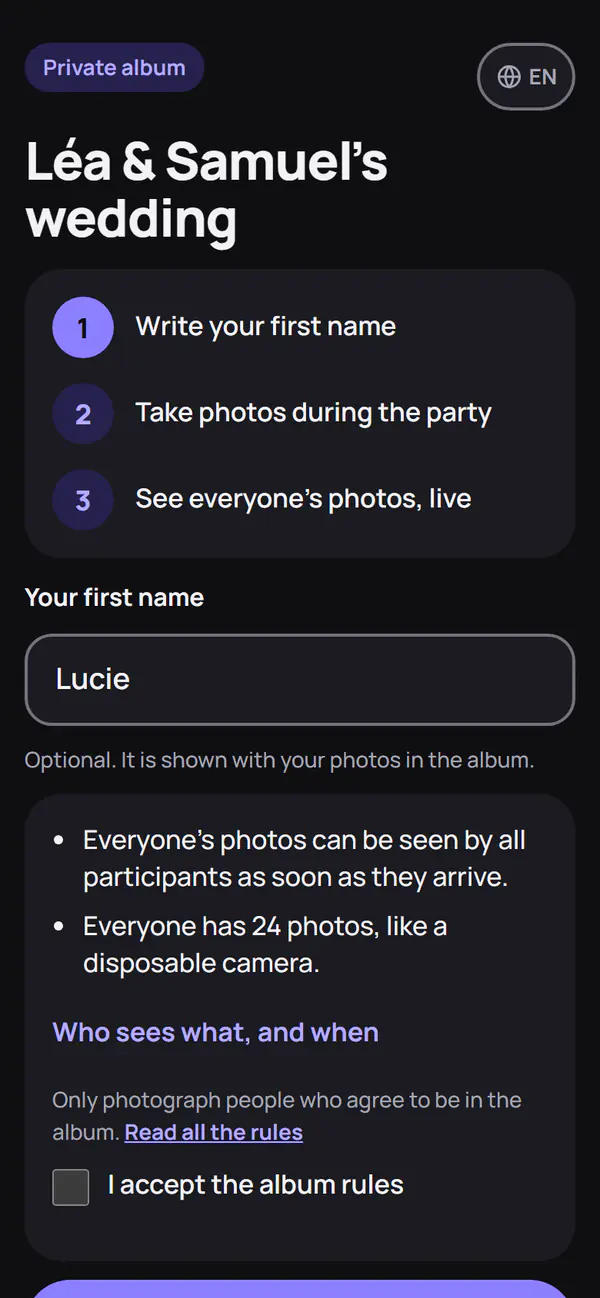
Festiroll is a web app: guests scan the QR code, on iPhone or Android, and start taking photos straight away, with no account or email address. For anyone who doesn't scan, the album link can be sent by text message. The idea is explained in QR code for wedding photos: how it works.
Original photo quality
For a photo book or prints, you need the original files, not reduced copies. Some messaging apps compress photos by default. Ask what the service keeps: the file that was sent, or a lighter copy.
In Festiroll, every photo is kept exactly as it was sent. Guests can also add photos they have already taken, from their camera roll, with the original file. The photographer uploads theirs in full quality, up to 64 MB per photo, in JPEG or PNG.
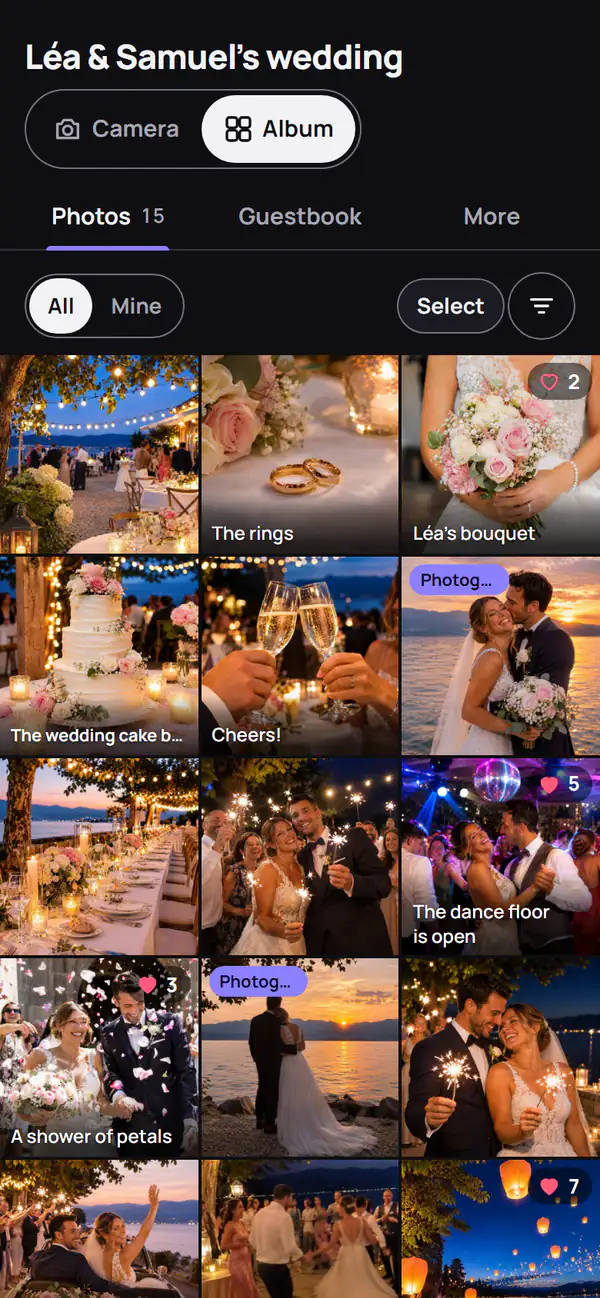
Photo hosting, data protection and GDPR
Wedding photos show faces, and children. Ask where they are stored, who can see them, and whether an album can turn up in a search engine.
Festiroll stores the photos in Switzerland, with Infomaniak, in private storage. No link to a photo exists before the moment someone is allowed to see it, and albums are kept out of search engines. No certification is claimed: the privacy policy follows the Swiss Federal Act on Data Protection (FADP) and, for the European Union, the GDPR.
Facial recognition: helpful or a step too far?
Some services find each guest's photos using facial recognition. It is convenient, but biometric data that identifies a person is sensitive data under Swiss data protection law.
Festiroll made the other choice: no facial recognition, and no artificial intelligence applied to photos or voices. Each guest can always see their own photos, and the name shown under a photo is the nickname the guest chose.
See them straight away, or reveal them later
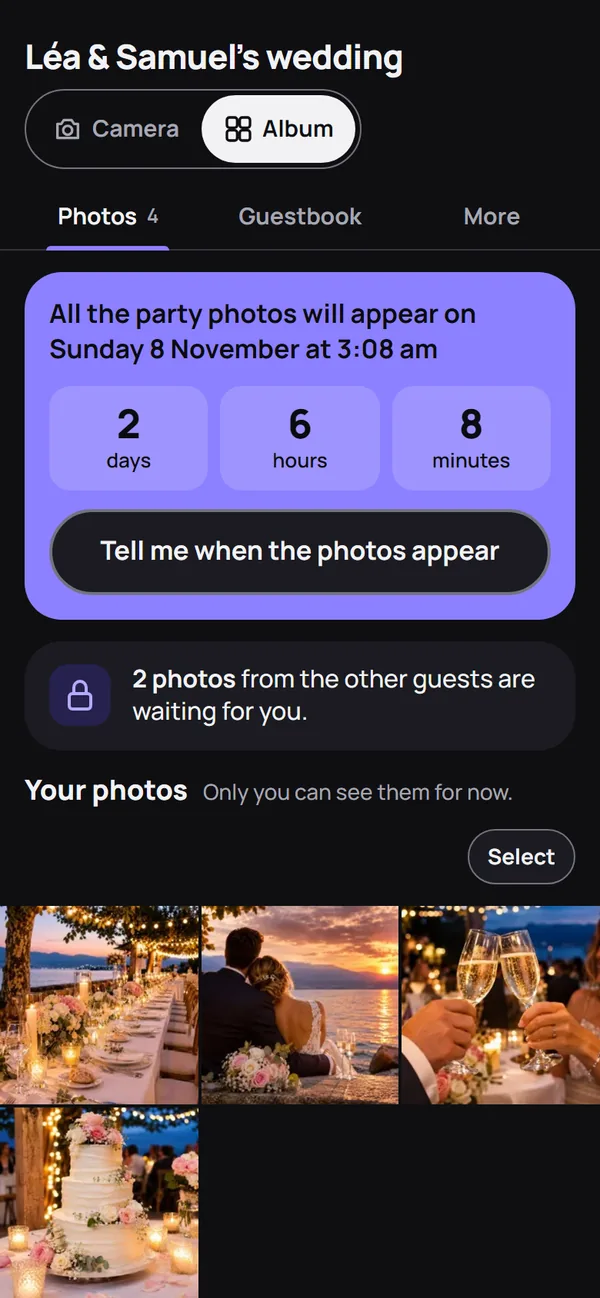
Watching photos arrive during the party livens up the evening; discovering them together the next day brings back the anticipation of a disposable camera.
Festiroll offers three modes:
- Live: everyone sees the others' photos as soon as they arrive;
- Surprise: unlimited photos per guest, revealed together at the time you choose;
- Disposable camera: 24 photos per guest, adjustable, revealed together.
Before the reveal, no one else's photos are sent to the phones, not even a thumbnail. To compare with real disposable cameras: Disposable camera app or film for your wedding?.
Where the photographer fits in
Guests' photos complement the professional coverage. Some services keep the two apart, others bring them together: ask your photographer what they prefer.
In Festiroll, the photographer has their own QR code. They upload their selection to the same album, on their own date, with a “Photographer” badge, and their delivery gallery stays their own. Details on the Photographers page.
Moderation and image rights
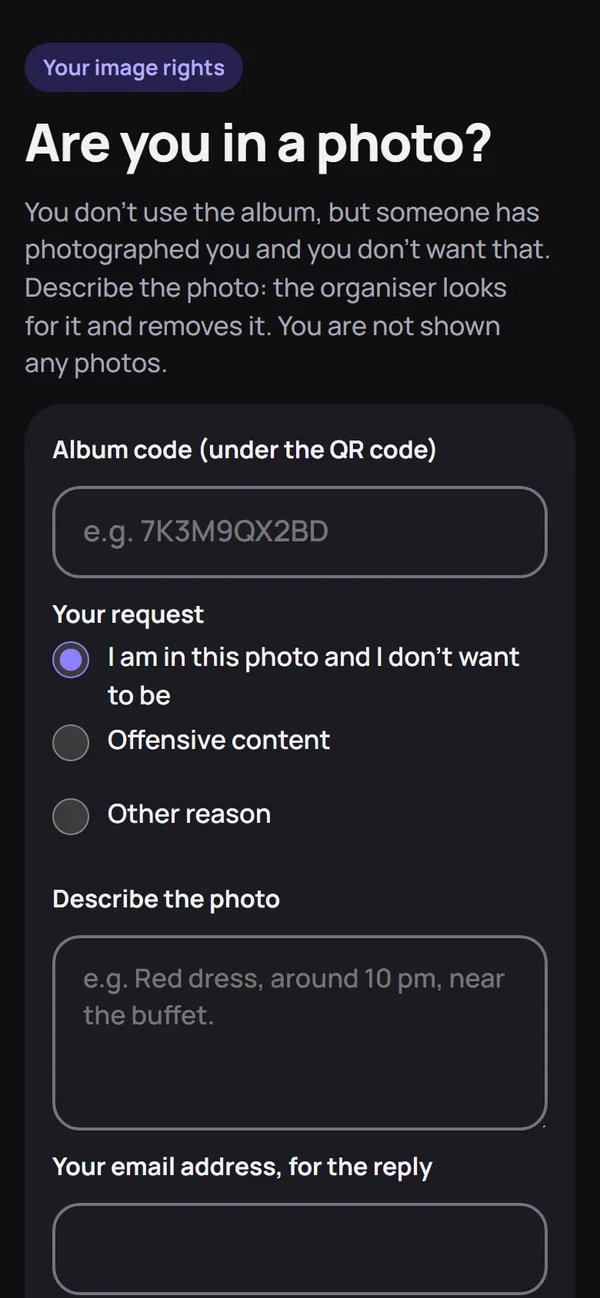
Some people don't want to be photographed, and there will be children. Check that a photo can be removed quickly, and that you can review photos before they become visible.
With Festiroll, a guest reports a photo from the album: it is hidden immediately, and the organiser decides within 72 hours. You can have every photo checked before it is published, with several moderators; this is required when children are present. The album rules are shown to every guest on the way in.
How long it is kept, and exporting
An online album is not an archive: ask how long it stays online, and how to get everything back in one go.
In Festiroll, the length depends on the plan: 12 months after the reveal with the Big party plan, and a paid plan can be extended. The organiser downloads the whole album in full quality, as a ZIP file, and guests can too if the organiser allows it. An email gives notice before deletion, then the album is deleted on the planned date.
One-off price or subscription
Pricing varies: monthly subscriptions, a price per event, day hire for a photo booth. A wedding is a one-off event, so compare the total cost, and look at what is limited: number of guests, photos, storage space, duration.
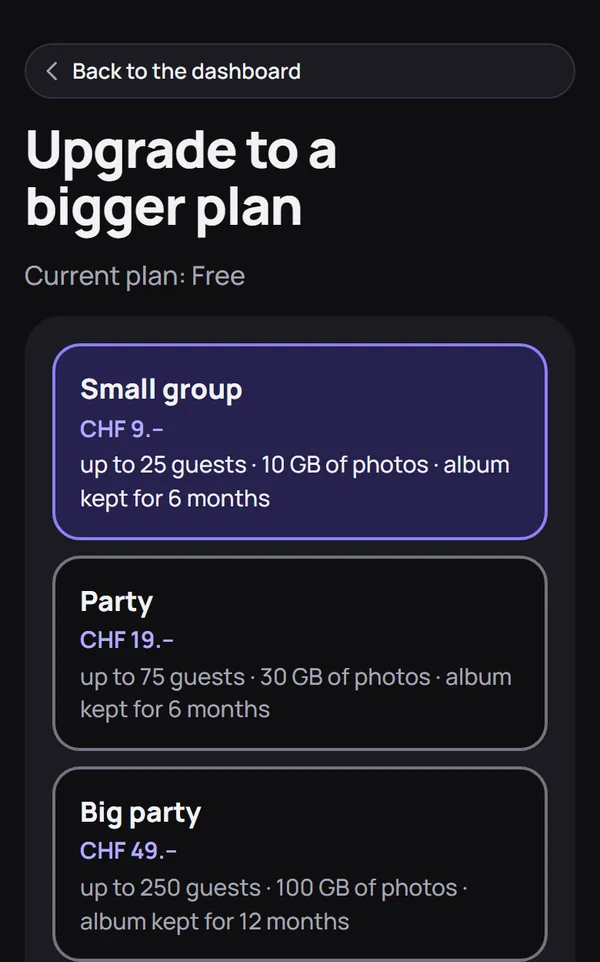
Festiroll is free for up to 10 guests, enough to try it with a few friends before the big day. Beyond that, a single price per event, from CHF 9.– to CHF 49.–, with no subscription and no ads; the Big party plan goes up to 250 guests. Details on the pricing page.
In short: the questions to ask
- Do guests have to install an app or create an account?
- Do photos keep their original quality?
- Where are they hosted, and who can see them?
- Is there any facial recognition?
- Can you choose when the photos are revealed?
- Can the photographer deliver into the same album?
- Can a photo be removed quickly?
- How long does the album stay online, and can you download everything?
- One-off price or subscription?
For setting it all up on the day: How to collect photos from your wedding guests. Every feature is on the Features page, and the wedding album on the Wedding page.